Immigration & Asylum Polygraph Testing: A Guide for Attorneys and Clients
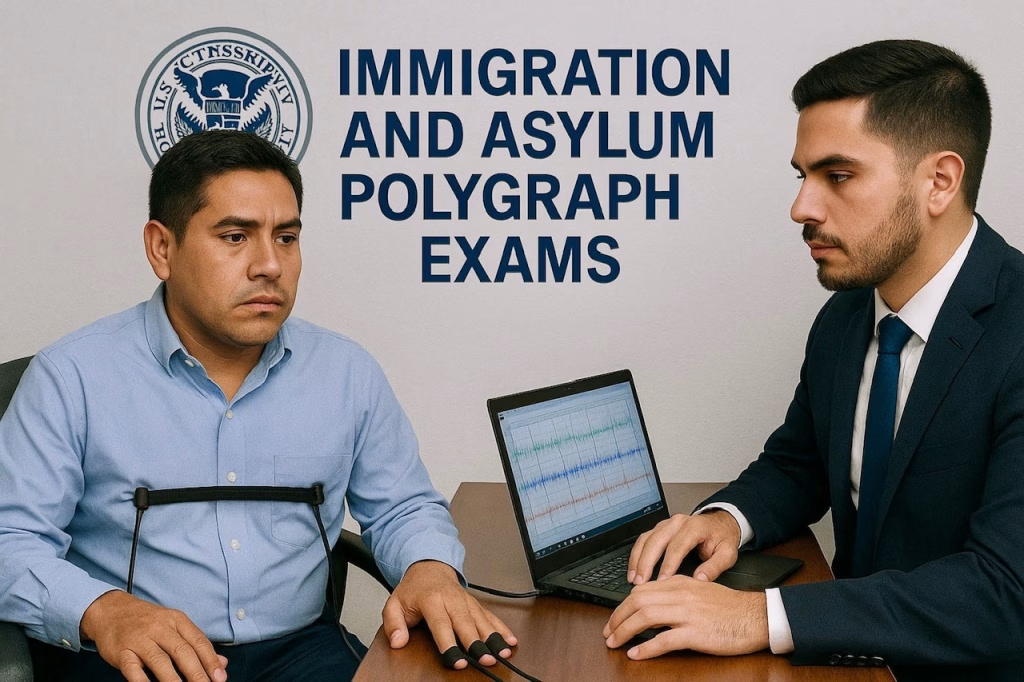
Immigration cases can involve important questions of credibility, particularly when records are missing, documentation is limited, or events occurred many years ago or outside the United States. Immigration Polygraph Testing can play a role in helping assess truthfulness in these situations.
In certain cases, an immigration attorney may consider a professionally administered polygraph examination as an additional tool for evaluating or corroborating a client’s account of a specific factual issue.
At Spectrum Polygraph Services, we provide professional immigration and asylum polygraph testing in Southern California. We work with immigration attorneys and their clients to develop clearly defined, case-specific questions addressing the factual issue involved.
Examinations are available in English and Spanish, and professional written reports can be provided to the referring attorney.
A polygraph examination does not determine immigration eligibility, replace required documentation, guarantee that evidence will be accepted, or substitute for legal advice. Whether a polygraph examination is appropriate—and whether its results should be submitted in an immigration matter—should be determined by the client’s immigration attorney.
What Is an Immigration Polygraph Examination?
An immigration polygraph examination is a credibility assessment focused on one or more clearly defined factual issues relevant to an immigration matter.
Unlike a general interview in which numerous subjects may be discussed, a properly structured polygraph examination focuses on carefully developed questions that can be answered clearly and evaluated using an appropriate validated testing technique.
Depending on the circumstances of the case and the attorney’s objectives, potential issues may involve:
- A claimed inspection and admission into the United States
- Circumstances surrounding a past entry into the United States
- Missing or unavailable documentation
- Marriage-related factual issues
- Specific allegations of marriage fraud
- Factual issues related to an asylum claim
- Past persecution or specific events associated with claimed persecution
- Criminal-history verification
- Specific factual issues relevant to a VAWA matter
- Other case-specific immigration credibility questions
Not every immigration issue is appropriate for polygraph testing. Before an examination is scheduled, the specific issue should be reviewed to determine whether it can be addressed through properly formulated polygraph questions.
Why Might an Immigration Attorney Consider a Polygraph?
Immigration cases sometimes involve events that occurred years or even decades earlier.
Documents may have been lost. Records from another country may be difficult to obtain. Witnesses may no longer be available. In other situations, a client’s account of an important event may be central to the case.
A polygraph examination may provide an attorney with an additional source of information concerning a specific factual assertion.
For that reason, Spectrum Polygraph Services encourages attorney involvement before the examination whenever the client is represented.
The attorney can explain the particular factual issue that needs to be addressed, provide relevant background information, and discuss proposed examination questions with the examiner.
The examiner ultimately determines whether the proposed issue and questions are suitable for polygraph testing and selects the appropriate examination format.
Matter of Quilantan and “Inspected and Admitted” Immigration Cases
One immigration issue that can involve significant questions of evidence and credibility is whether an individual was previously inspected and admitted into the United States.
In Matter of Quilantan, 25 I&N Dec. 285 (BIA 2010), the Board of Immigration Appeals addressed the meaning of “admitted” for purposes of adjustment of status under section 245(a) of the Immigration and Nationality Act.
The case involved an individual who testified that she approached a port of entry as a passenger in a vehicle. According to her testimony, an immigration inspector questioned the driver but did not question her and then allowed the vehicle to proceed into the United States.
Situations involving an alleged “wave-through” entry can create evidentiary challenges when the event occurred many years ago and there is little or no documentary record of the encounter.
Can a Polygraph Prove a Quilantan Entry?
A polygraph examination does not independently establish that an individual satisfies the legal requirements of Matter of Quilantan or qualifies for adjustment of status.
Those are legal determinations.
However, when an attorney determines that the circumstances of a client’s claimed entry are relevant, a polygraph examination may be considered as an additional credibility-assessment tool addressing specific factual assertions concerning that entry.
For example, rather than asking a legal conclusion such as:
“Were you legally admitted into the United States?”
the examination should focus on clearly defined factual conduct or events identified through consultation with the attorney and examinee.
This distinction is important. Polygraph examiners evaluate responses to factual questions; they do not make immigration-law determinations.
Polygraph Testing When Immigration Documents Are Missing
Some immigration matters involve events for which original documentation is no longer available.
Records may have been lost, destroyed, never created, or may be difficult to obtain because the event occurred in another country or many years earlier.
When credibility concerning a specific historical event is important, an attorney may consider whether a polygraph examination could provide useful supplemental information.
The examination should not be presented as a replacement for documentation that immigration authorities require. Instead, it addresses the truthfulness of the examinee’s responses to carefully formulated factual questions.
Asylum Polygraph Examinations
Asylum cases can involve highly personal accounts of events occurring outside the United States, including allegations of threats, violence, detention, mistreatment, or persecution.
In appropriate circumstances, an attorney may wish to obtain an independent credibility assessment concerning a specific factual event described by the client.
An asylum polygraph should not attempt to answer legal questions such as whether the individual “qualifies for asylum” or whether the person has a legally sufficient “well-founded fear of persecution.”
Those determinations belong to immigration authorities and the courts.
Instead, when suitable for testing, questions should address clearly defined factual conduct or events.
This limitation is especially important in light of Goel v. Gonzales, a Ninth Circuit case involving polygraph evidence. The court held that the polygraph evidence at issue could not establish prima facie eligibility for asylum and could not serve as the basis for reopening under the circumstances of that case. The court nevertheless stated that its decision did not necessarily preclude discretionary consideration of polygraph evidence at earlier stages of removal proceedings.
For this reason, attorneys should determine whether a polygraph examination is appropriate for their particular case and how, if at all, the results should be used.
Marriage-Based Immigration and Marriage Fraud Polygraph Testing
Marriage-based immigration cases may involve questions concerning the legitimacy of a relationship or allegations that a marriage was entered into primarily to obtain an immigration benefit.
A polygraph examination cannot determine whether USCIS or an immigration court will recognize a marriage as bona fide.
However, when a particular factual allegation is disputed, an attorney may consider polygraph testing as one component of the overall case assessment.
Potential examination topics must be narrowed to specific factual conduct rather than broad questions about whether a marriage is “real” or “fraudulent.”
Every case is different, which is why Spectrum Polygraph Services reviews the circumstances before finalizing examination questions.
VAWA-Related Polygraph Examinations
Cases involving the Violence Against Women Act (VAWA) require particular care.
USCIS provides for consideration of credible evidence in VAWA self-petition matters, and the credibility and weight of evidence are evaluated in the context of the individual case.
A polygraph examination does not establish VAWA eligibility and should never be represented as doing so.
When an attorney believes a specific factual matter may be appropriate for credibility assessment, Spectrum Polygraph Services can discuss whether that issue can be properly addressed through polygraph testing.
Because these cases may involve traumatic experiences, domestic violence, and highly sensitive personal information, examinations should be handled professionally, respectfully, and with careful attention to the examinee’s circumstances.
Criminal History Verification
Obtaining reliable criminal-history records from another country can sometimes be difficult.
Depending on the circumstances and the attorney’s objectives, a polygraph examination may be considered to address clearly defined questions concerning undisclosed criminal conduct or other specific historical issues.
A polygraph examination is not a criminal-background check and does not replace official records. Its purpose is to assess responses to the specific questions presented during the examination.
Other Immigration Issues That May Be Considered
Immigration matters vary significantly, and there is no single set of polygraph questions appropriate for every case.
Potential case-specific issues may include:
- Circumstances of entry into the United States
- Claimed inspection and admission
- Missing-document issues
- Specific conduct associated with an immigration application
- Marriage-related allegations
- Criminal-history issues
- Specific events associated with an asylum claim
- Particular factual allegations affecting credibility
The examiner must determine whether the requested issue is suitable for polygraph testing.
How Does an Immigration Polygraph Examination Work?
1. Initial Case Review
When possible, Spectrum Polygraph Services first communicates with the referring immigration attorney to understand the factual issue the attorney wants evaluated.
Relevant case information can be reviewed before the appointment so that the examination remains focused on the appropriate issue.
2. Question Development
The attorney may provide input concerning the factual matters that need to be addressed.
The examiner then develops questions that are clear, objective, understandable, and suitable for polygraph testing.
Questions are reviewed with the examinee before testing. There are no surprise relevant questions during the examination.
3. Pre-Test Interview
The examiner conducts a detailed pre-test interview with the examinee.
The process and examination questions are explained and reviewed before any physiological data are collected.
This portion of the examination also allows the examiner to clarify terminology, discuss the issue being tested, and determine whether circumstances exist that could affect the examination.
4. Polygraph Examination
After the pre-test process is completed, physiological data are collected while the examinee answers the previously reviewed questions.
The examination is conducted using established polygraph procedures and an appropriate testing technique based on the issue being evaluated.
5. Analysis and Results
After data collection, the examination charts are analyzed and scored.
The results are then documented according to the circumstances of the examination.
6. Professional Written Report
When requested, Spectrum Polygraph Services can prepare a professional written report for the referring attorney documenting the examination, questions asked, examinee’s answers, and examination results.
How Accurate Is Polygraph Testing?
Polygraph accuracy should be discussed in the context of the particular testing technique used rather than by claiming that every polygraph examination has one universal accuracy rate.
The American Polygraph Association’s Meta-Analytic Survey of Criterion Accuracy of Validated Polygraph Techniques reviewed 38 qualifying studies.
For techniques intended for event-specific diagnostic testing, the APA reported an aggregated decision accuracy of 89%, with a confidence interval of 83% to 95% and an estimated inconclusive rate of 11%.
Those statistics describe aggregated research findings for validated techniques under the conditions examined in the research. They should not be interpreted as a guarantee of accuracy in an individual immigration examination.
Technique selection, question formulation, examiner training, examination procedures, data quality, and the examinee’s suitability for testing all matter.
Can Polygraph Results Be Submitted in an Immigration Case?
This is a question for the client’s immigration attorney.
The treatment and weight of polygraph evidence can depend on the proceeding, jurisdiction, purpose for which the evidence is offered, and the discretion of the decision-maker.
Spectrum Polygraph Services does not provide legal advice and does not determine whether an examination report should be submitted to USCIS, an immigration court, the Board of Immigration Appeals, or another government agency.
When the examinee is represented, we encourage the client to discuss the examination and potential use of the results with their immigration attorney.
Immigration Polygraph Examinations in Spanish
Spectrum Polygraph Services provides polygraph examinations in both English and Spanish.
Being able to communicate directly with the examiner can be particularly important in an immigration examination because the examinee must fully understand the terminology and meaning of every test question.
Questions are thoroughly reviewed before testing to ensure that the examinee understands exactly what is being asked.
Choosing a Polygraph Examiner for an Immigration Case
Immigration matters can have serious consequences, so attorneys and clients should carefully evaluate the qualifications of the examiner they select.
Consider the examiner’s:
- Formal polygraph education and professional training
- Experience conducting specific-issue examinations
- Knowledge of validated polygraph techniques
- Ability to formulate narrow, fact-based questions
- Experience working with attorneys
- Professional reporting practices
- Ability to conduct the examination in the examinee’s preferred language when appropriate
The polygraph examiner should also understand the limits of the examiner’s role. The examiner conducts a credibility assessment; the examiner does not provide legal opinions or determine immigration eligibility.
Immigration & Asylum Polygraph Testing in Southern California
Spectrum Polygraph Services provides professional immigration and asylum polygraph examinations for attorneys and their clients throughout Southern California.
Our office is located in Hacienda Heights, California, and examinations are available by appointment, including evening and weekend availability.
We provide examinations in English and Spanish and work directly with referring attorneys when requested to review the specific issue and proposed polygraph questions before testing.
Immigration attorneys who would like to discuss whether a particular factual issue may be suitable for polygraph testing are welcome to contact us before referring a client.
Spectrum Polygraph Services
Hacienda Heights, California
(562) 245-9655
Frequently Asked Questions About Immigration Polygraph Testing
Can a polygraph help an immigration case?
A polygraph may provide supplemental credibility information concerning a specific factual issue. Whether it is appropriate or useful in a particular immigration case should be determined in consultation with the client’s immigration attorney.
What is a Quilantan polygraph?
“Quilantan polygraph” is an informal term sometimes used for a polygraph examination addressing factual circumstances surrounding a claimed inspection and admission or “wave-through” entry potentially relevant to Matter of Quilantan. A polygraph does not itself establish that an individual satisfies the legal requirements of Quilantan.
Can a polygraph prove that I was inspected and admitted?
A polygraph examination does not legally establish inspection and admission. It may assess responses to properly formulated factual questions concerning the circumstances of a claimed entry. The immigration attorney determines how that information relates to the client’s case.
Can a polygraph be used for an asylum case?
An attorney may consider a polygraph examination concerning specific factual events relevant to an asylum matter. A polygraph cannot determine whether someone legally qualifies for asylum or establish the objective reasonableness of a claimed fear of persecution.
Can polygraph testing be used in a marriage immigration case?
Potentially. When a specific factual allegation concerning a marriage is disputed, an attorney may consider whether the issue is suitable for polygraph testing. A polygraph does not determine whether a marriage is legally bona fide.
Can a polygraph be used in a VAWA case?
An attorney may consider polygraph testing concerning a specific factual issue when appropriate. The examination does not establish eligibility for VAWA relief and should be treated as supplemental information rather than a substitute for required evidence.
Does USCIS accept polygraph results?
There should not be a blanket assumption that USCIS will accept or give a particular amount of weight to a polygraph report. Attorneys should evaluate whether a report is appropriate for the specific proceeding and client.
Can my immigration attorney help develop the questions?
Yes. Spectrum Polygraph Services can work with the referring attorney before the examination to understand the factual issue and review proposed areas of inquiry. The examiner makes the final determination regarding question wording and testing suitability.
Are immigration polygraph examinations available in Spanish?
Yes. Spectrum Polygraph Services provides immigration and asylum polygraph examinations in both English and Spanish.
Where can I get an immigration polygraph in Southern California?
Spectrum Polygraph Services conducts immigration and asylum polygraph examinations at our Hacienda Heights, California office and serves clients and attorneys throughout Southern California. Evening and weekend appointments are available.
Schedule an Immigration Polygraph Consultation
If you are an immigration attorney considering a polygraph examination for a client, Spectrum Polygraph Services can review the specific factual issue with you before an examination is scheduled.
Key Takeaways
- Immigration Polygraph Testing helps assess credibility in immigration cases where documentation may be lacking.
- Spectrum Polygraph Services offers professional examinations in Southern California to assist immigration attorneys and their clients.
- Examinations focus on specific factual issues, such as past entries or marriage-related allegations, but do not determine immigration eligibility.
- Attorneys should work closely with examiners to develop appropriate questions tailored to the case.
- Polygraph results can offer supplemental information but should not replace required documentation or legal advice.
Call Spectrum Polygraph Services at (562) 245-9655 to discuss an immigration or asylum polygraph examination in Southern California.
This article is provided for general informational purposes and is not legal advice. Spectrum Polygraph Services does not determine immigration eligibility or guarantee that a polygraph examination or report will be accepted or afforded any particular weight by USCIS, an immigration court, or any other government agency.