
Quick Answer: Considering a pre-employment polygraph test can be a complex decision for both employers and applicants.
A pre-employment polygraph test is a specialized lie detector examination used to verify a candidate’s honesty and integrity during the hiring process. It helps employers confirm the truth about an applicant’s background, past conduct, and qualifications, ensuring a safer, more trustworthy workplace. When conducted by certified examiners, single-issue tests can reach 90–95% accuracy.
What is a Pre-Employment Polygraph Test?
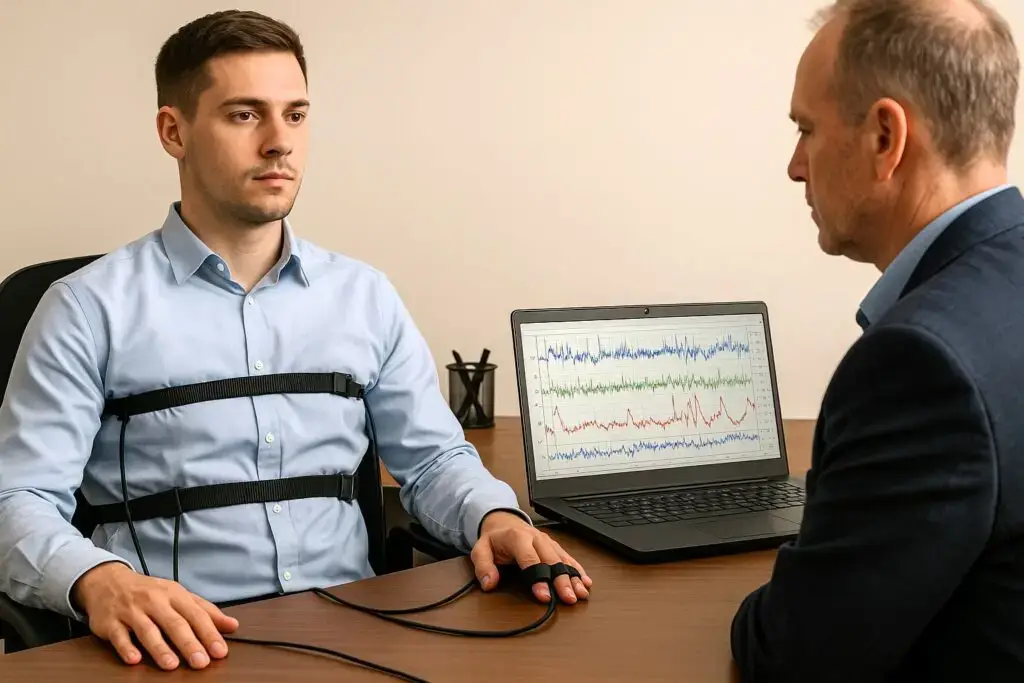
A pre-employment polygraph is designed to measure physiological responses — such as heart rate, respiration, blood pressure, and perspiration — while an applicant answers specific yes/no questions related to their background.
These tests are commonly used by:
- Law enforcement agencies
- Security companies
- Government agencies
- Private employers with high-trust roles
The goal is to detect potential risks before making a hiring decision, while complying with applicable employment laws.
Why Employers Use Pre-Employment Polygraph Testing
Employers request pre-employment exams to:
- Confirm honesty in applications and interviews
- Verify past employment and job history
- Detect undisclosed criminal activity
- Screen for substance abuse
- Identify conflicts of interest or policy violations
Industries That Commonly Require Polygraph Testing
- Law Enforcement & Public Safety – Police, sheriff, corrections, fire service.
- Government Agencies – Federal, state, and municipal security positions.
- Private Security Firms – Armed guards, armored transport, sensitive site security.
- Financial Institutions – High-risk fraud prevention positions.
- Transportation & Logistics – Cargo security, airport screening.
How the Pre-Employment Polygraph Process Works
1. Employer Engagement
The employer outlines the position’s requirements and the scope of the screening.
2. Candidate Preparation
The applicant receives instructions and a general overview of what to expect.
3. Pre-Test Interview
The examiner reviews the purpose, explains the process, and confirms understanding of all questions.
4. Examination
Sensors are applied and questions are asked in a consistent, non-intimidating manner.
5. Analysis & Results
Data is reviewed, and results are provided to the requesting employer.
Sample Pre-Employment Polygraph Questions
- “Have you ever lied on your job application?”
- “Have you used illegal drugs in the past [time period]?”
- “Have you committed a theft from a previous employer?”
- “Have you ever been convicted of a felony you did not disclose?”
- “Have you intentionally omitted information from your background forms?”
Accuracy & Legal Considerations
- Accuracy: When done by certified examiners using modern computerized instruments, results can reach 90–95% accuracy for single-issue testing.
- Legal Limits: In the United States, the Employee Polygraph Protection Act (EPPA) generally prohibits most private employers from using polygraph tests, with specific exemptions for certain industries.
- Public Agencies: Law enforcement and government positions are exempt from EPPA restrictions.
Benefits of Pre-Employment Polygraph Testing
- Improves hiring decisions by filtering out high-risk candidates.
- Protects organizational integrity and reputation.
- Saves costs by avoiding bad hires and turnover.
- Enhances workplace safety in sensitive roles.
Statistics on Background Misrepresentation
- 46% of job applicants admit to lying on resumes (CareerBuilder).
- 78% of employers have caught candidates misrepresenting themselves in applications.
- Polygraph testing remains one of the most effective deterrents against falsifying job histories.
Step-by-Step Guide for Employers
- Define Screening Criteria – Identify the position(s) requiring testing.
- Coordinate with Spectrum Polygraph Services – Provide job details and scope.
- Schedule Candidate Testing – Arrange convenient dates and times.
- Review Results – Use findings as part of the overall hiring decision.
- Document & Comply with Law – Maintain lawful procedures and applicant rights.
Frequently Asked Questions (FAQ)
Q: Can all employers require a polygraph test?
A: No. Private employers are limited by EPPA, with exceptions for security, armored transport, pharmaceuticals, and certain government contractors.
Q: How long does the process take?
A: Typically 1.5–2 hours per applicant.
Q: Will the applicant’s refusal mean they are disqualified?
A: This is up to the employer’s policy and legal framework.
Q: Are the results confidential?
A: Yes. Results are provided only to the requesting employer.
Q: Can multiple candidates be tested in one day?
A: Yes, we can arrange high-volume testing sessions for agencies and companies.
Why Choose Spectrum Polygraph Services
- Certified Examiners with law enforcement backgrounds
- Bilingual Services (English & Spanish)
- Confidential, Professional Testing
- Flexible Scheduling including evenings/weekends
- Mobile Testing Available for agencies and employers
Contact Us to Schedule Your Pre-Employment Polygraph Exams
🌐 SpectrumPolygraphs.com
